Users Are Not Customers (And I Need Both)
People who use the product vs. those who pay for it, are not the same.
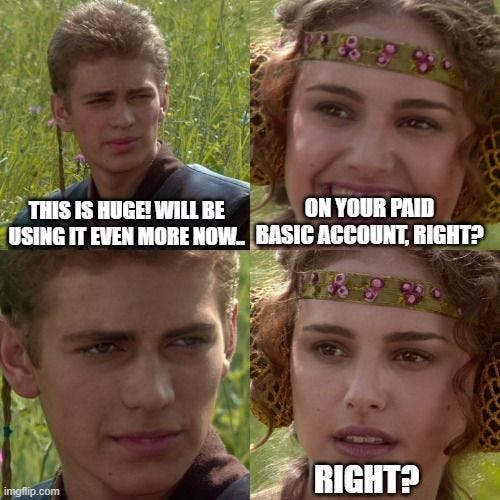
I keep saying “I need users.” Half the time I mean feedback. Half the time I mean revenue. Those are different hunts.
“Find users” hides two things
When you’re starting anything—a side project, a company, whatever—the whole week looks like: find people.
A user is someone who actually goes through the product. They share a card. They get stuck. They text me “wait, where’s the QR?” or “how does this work?” They cost me money too—hosting, my time, database queries, and the sheer mental energy of reading “this is confusing.”
A customer is someone who pays. Subscription, one-time fee, I don’t know the exact model yet. But money moves. That money is how you stop eating every server cost yourself and actually have something left over to build the next version.
If I only collect users, I can feel incredibly busy while still being the only person funding this. If I only chase paid people before anyone has even touched the thing, I’m selling a story with no scars.
I need both. Just not at the same time.

First: a small free beta
I’m not starting with ads. I’m not starting with “freemium at scale.”
I want a live beta. Open enough that strangers can get in, but small enough that I can still talk to them. Roughly 10 to 20 people (though ideally, I’d love 100 😉). Free. Full product—not a fake demo with half the buttons missing.
The deal is simple: use it, break it, tell me the truth.
Why free? Because I can’t charge with a straight face yet. I need the feedback and people actually talking about the product more than I need their money right now. Every free seat is still an expense. Firebase. My evenings. Me. I’m buying learning on purpose.
Later: people who pay
After that initial group has shown me what’s broken and how to improve, the hunt changes.
I’m not trying to keep everyone free forever. I want to learn who gets enough value out of this that paying feels fair—then go find more of those people.
Someone who shares cards at events and actually comes back after the conference is a very different animal from “I downloaded it once because it said free.”
That’s the part where this stops being a hobby, with the hopes of being a real business someday.
Freemium vs. paid (I’m not deciding the final model here)
A lot of people default to freemium. Give away the good stuff, monetize later with ads or a paywalled upsell. It feels generous. It also trains everyone that the real product is free while your costs keep climbing.
Paid or subscription is a different deal entirely. The person who pays is usually living in the product—not because a paywall forced them to, but because they use it enough that the cost makes sense.
I’m not publishing a price today. I’m just establishing the order of operations:
Free beta first. Paid people after I’ve learned something.
And I’m not going to pretend a free download and a paying customer are the same win.
How I’ll know it’s working
For the beta: Did they finish a hand-off without me sitting next to them? Did they come back and say, “this is a good idea”? Did they point out something I haven’t even thought of yet? Or does this project suck so bad that I either need to pivot or try a completely different project?
For paid: Does the money cover running this thing—including whatever free seats I still choose to keep around? Is there anything left to build the next feature, or am I just subsidizing strangers?
Feedback keeps the product honest. Revenue keeps me from burning out. I want the first so I can earn the second.
Recap
I’m Luciano Huapaya. I’m building mee.contact in public—an app to automate the contact exchange so you can stay present when you meet people. Personas for what you share, Connections for who you meet, Events for where you met them. Not on the App Store yet. This is the journal of getting there.
Join My Newsletter
Follow along to see how we build mee.contact. The good, the bad, the ugly.
By subscribing, you’ll get new posts by email. Unsubscribe anytime.