The Contact Sharing Market
I opened Sensor Tower because I was tired of competing against vibes.
Blinq, Dot, Popl, and HiHello—I already knew the names. What I didn’t know was how the App Store actually treats them: downloads, estimated revenue, whether anyone is buying ads. The category has marketing blogs. I wanted a second view.
The short version: this market is real, monetized, and forked. Different apps are optimizing for different moments. Contact Share still sits in a quieter bet—stay present in the room, remember who you met afterward—but pretending the field is empty would be dishonest.
High Level: Where the Category Sits
Digital business cards are no longer a novelty category. Named apps, freemium plans, team seats, CRM hooks, NFC hardware, Wallet passes—that stack exists.
Below is a table of digital vs paper at a glance from Lynkle’s 2026 article so we are on the same page.
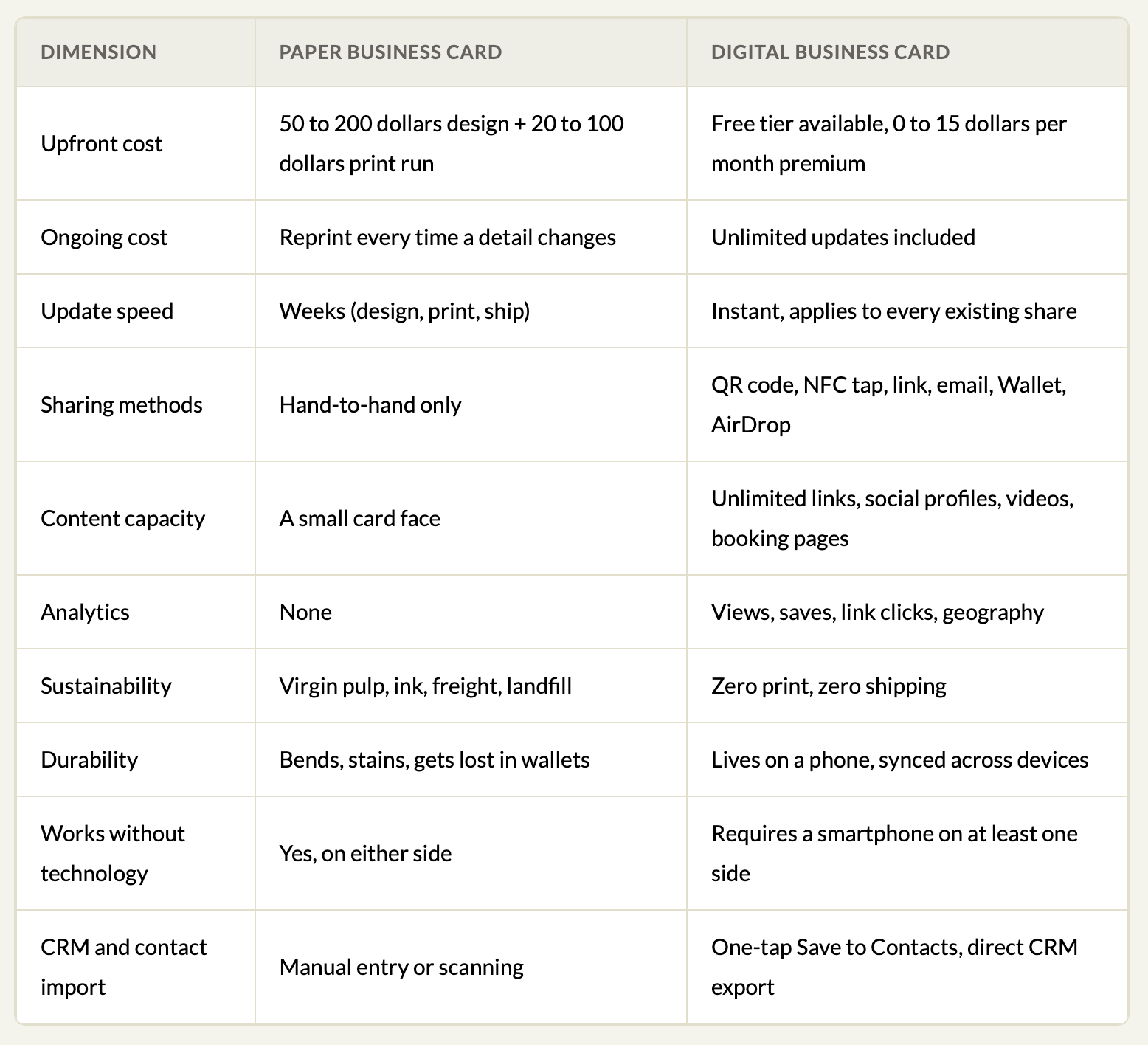
I read Lynkle’s 2026 digital-vs-paper comparison the same way I’d read any competitor’s blog: aware of the perspective, not trusting every number. What survives my filter:
Claim (via Lynkle / Market.us)
How I’m Holding It~$200M market in 2024, ~11–12% CAGR = Directionally useful; third-hand market-sizing, not my diligence.
Paper cards discarded / under-saved = Matches lived experience; sample caveats apply.
Hybrid (paper + QR) as 2026 default = Feels right for trade shows and formal industries.
Wallet closing “phone-or-nothing” gap = Real product surface—worth watching.
I don’t need Lynkle’s conclusion to believe digital hand-offs matter. Because I have lived it through conferences I have attended in the past. I need it as one industry POV next to App Store estimates and funding news.
App Store Signal (Sensor Tower, ~Jul 2026)
Worldwide, last month—estimates, not audited company books. RPD / DAU / time-spent tiles are behind a paywall on these screens; I’m not inventing them.
Blinq: ~80K downloads (WW) | ~$300K revenue (WW)
Note: Ranked US Business downloads #90; ad spend is currently inactive.
Popl: ~10K downloads (WW) | ~$200K revenue (WW)
Note: Far fewer downloads than Blinq, but revenue is close. Driven by active ad spend.
Dot: ~8K downloads (WW) | ~$20K revenue (WW)
Note: Smaller iOS App Store slice; hardware sales live largely outside of App Store IAP.
The trend line I’m taking from that table:
Blinq leads volume in this iOS estimate set.
Popl punches above weight on revenue per download—consistent with enterprise/event GTM pricing, not just consumer freemium.
Dot looks smaller on App Store estimates—which fits a hardware-first model where devices and direct web sales don’t all show up as mobile IAP.
Three strategic forks in one category:
Polished share card + teams (Nearest: Blinq)
Optimizing for: Viral sharing, brand design, and basic relationship tools.
In-person lead / event pipeline (Nearest: Popl)
Optimizing for: Badge scanning, contact enrichment, and direct CRM syncing.
Tap hardware + profile link (Nearest: Dot)
Optimizing for: The physical NFC object as the core product experience.
Blinq
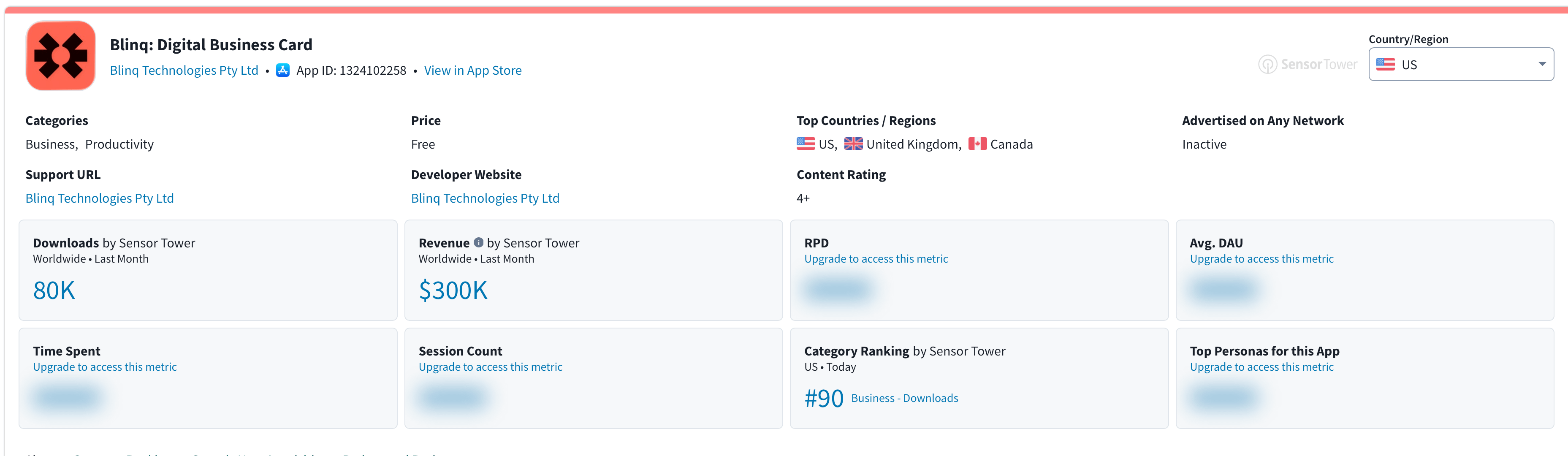
~80K downloads / ~$300K revenue in that window. On this board, Blinq is the volume + category brand leader.
Capital followed that gravity. In May 2025, Blinq announced a US$25M Series A led by Touring Capital, with Blackbird, Square Peg, and HubSpot Ventures—covered by TechCrunch and AU press. Company claims around the raise (treat as claimed, not audited): ~2.5M users across ~500K companies, and a 2025 target north of 50M card shares.
HubSpot Ventures in the round is a tell: the story isn’t only “replace paper.” It’s start of the relationship → tools that keep the relationship in motion.
What I’d borrow: Clarity of the first share moment—QR / card chrome that reads in three seconds.
What I’d refuse: Becoming another analytics-and-teams dashboard for professionals who already live in CRM. My constraint is the room, not the org chart.
Popl
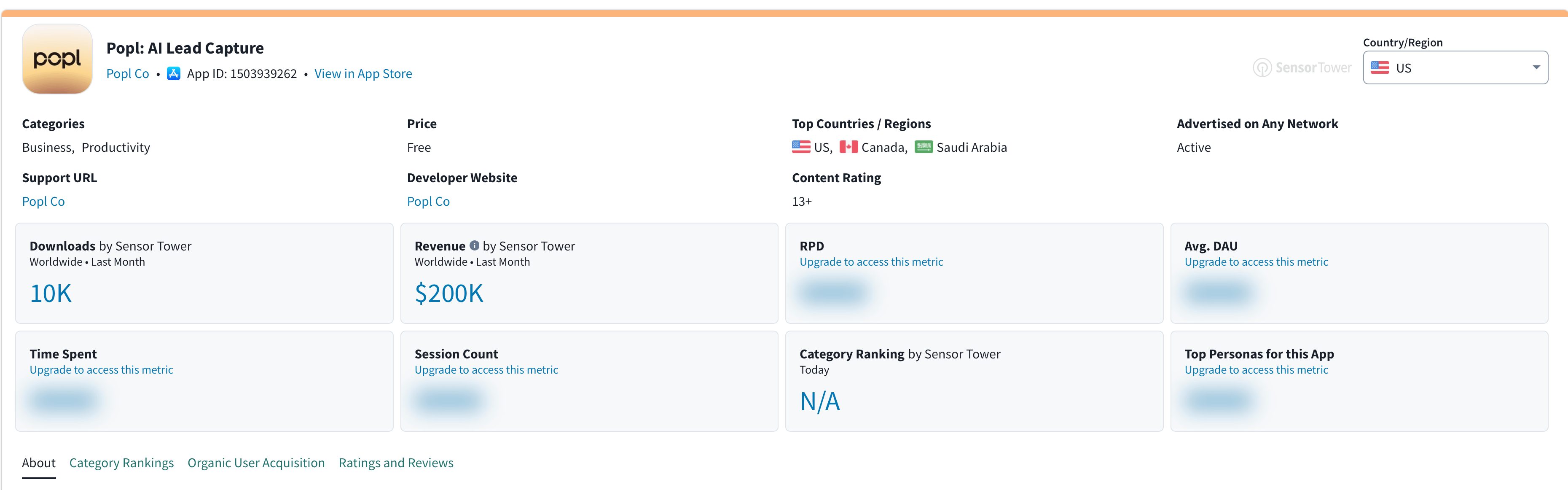
~10K downloads / ~$200K revenue. That ratio is the story. Fewer people downloading the consumer-looking app; a lot of money relative to that download base. Sensor Tower also shows active advertising—they’re paying for users (or for the right users).
Positioning has moved. A Variety piece on Popl’s rebrand frames the company less as “digital business card” and more as in-person / event lead capture: AI badge scanning, enrichment, CRM sync, meeting the booth-scanner world head-on.
Popl (The Sales Angle):
Goal: Pipeline (lead → enrich → CRM).
Buyer: Sales, GTM, and field marketing teams.
Success Metric: Cost per lead and follow-up speed.
Respect the monetization.
Dot
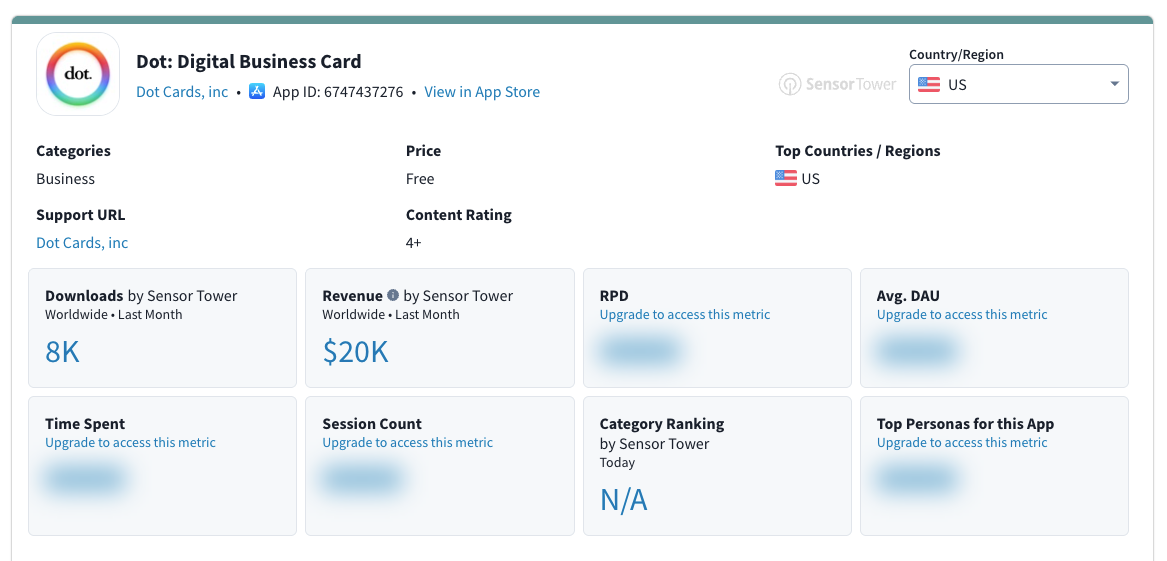
~8K downloads / ~$20K revenue on this iOS estimate slice. Smaller than Blinq and Popl here—and that’s incomplete if you only look at the App Store.
Dot sells the object: NFC cards, bands, metal variants. Tap (or scan QR) → profile in the browser; recipient doesn’t need the app. Profile+ / subscriptions monetize extras on top of the one-time device. App Store IAP is only part of the P&L.
That distribution is physically different from pure software. You’re buying a token you carry—closer to the paper ritual than a settings screen. Hybrid paper+QR narratives (Lynkle again) rhyme with Dot’s hardware story even when Dot isn’t writing the blog.
HiHello (Still on the Board)
No Sensor Tower screenshot in this post—I’m not inventing metrics I didn’t capture.
HiHello matters as proof the category has had multiple funded lives. Series A was $7.5M in 2021, after an earlier seed; older TechCrunch coverage frames contact management + digital cards as the thesis. They’re still named in roundup tables (including Lynkle’s alternatives list). They’re not the 2025 capital headline Blinq was—but the long tail doesn’t disappear when one series A ships.
Lesson for a solo builder: this space attracts capital in waves. Survivors and quiet apps both exist. Market size ≠ automatic distribution for me.
My takeaways
Category money is concentrated where venture and teams already know how to pay:
Share polish and brand (Blinq)
Teams / CRM gravity (Blinq’s investor mix; Popl’s sync story)
Events as pipeline (Popl)
Hardware as SKU (Dot)
Incumbents can own the glossy card and the sales pipeline. I’m building for the person who wants the conversation more than the CRM row.
I am not saying that I won’t build towards populating data into the CRM right now, because there is money there 100% percent. I want to narrow my focus to encapsulate just basic contact sharing right now to focus on for quicker user acquisition out the gate.
The market is crowded. That’s confirmation the problem is worth money—not a reason to cancel the bet.
Recap
I’m Luciano Huapaya. I’m building Contact Share in public —an iOS app to automate the contact hand-off so you can stay present when you meet people.
Shareable Personas: Different cards for different contexts.
Connections: People you met, not just entries in your phone book.
Events: Grouping who you met where.
It’s not in the App Store yet. This is the journal of getting there.
Join My Newsletter
Follow along to see how we build mee.contact. The good, the bad, the ugly.
By subscribing, you’ll get new posts by email. Unsubscribe anytime.